If you have spent any time watching sustainability channels or environmental tech documentaries like the popular “Bright Ideas” channel, you have likely seen viral footage of beautiful, lush green wetlands filtering black wastewater into completely clear water.
It looks like absolute magic. In an urban landscape like Delhi-NCR—where traditional municipal infrastructure is continuously strained by explosive population growth—the idea of using nature to heal our rivers is incredibly compelling.
But how do these systems actually hold up when subjected to real-world fact checks? Let’s step back from corporate marketing narratives and look at the actual science, the verified Indian milestones, and the honest pros and cons of the reed bed and duckweed revolution.
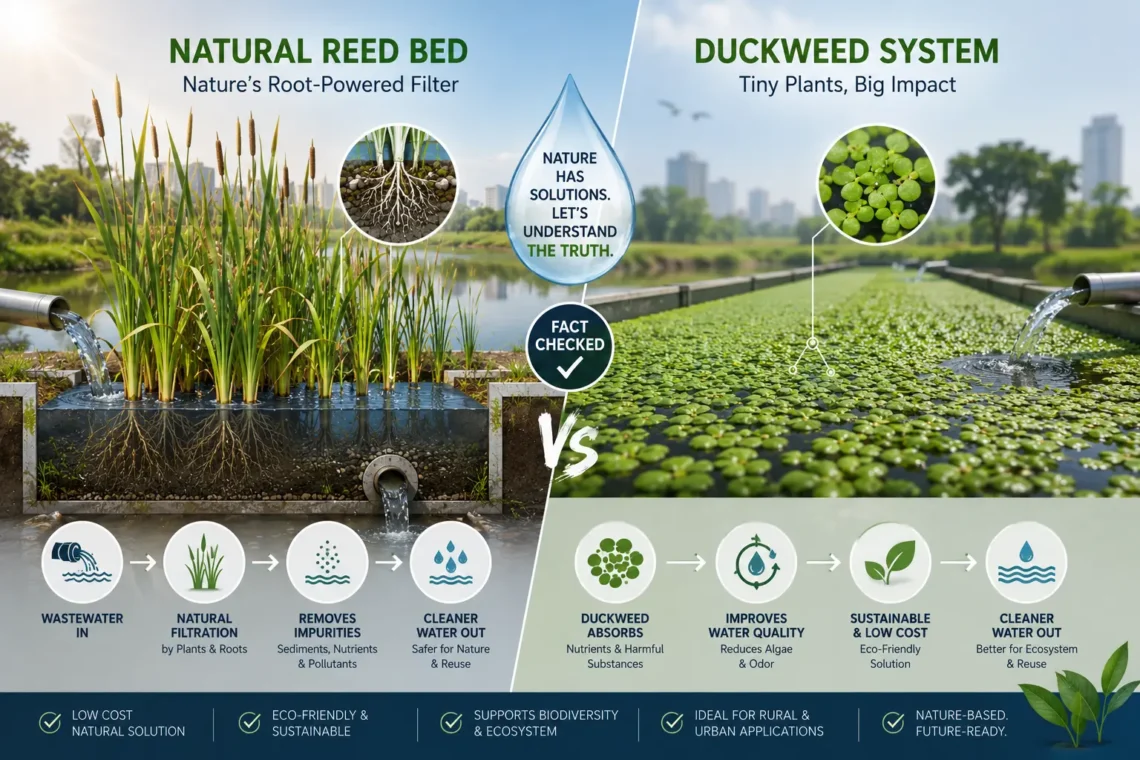
The Ecological Mechanics: How Reed Beds and Duckweed Interlock
To evaluate what this technology brings to society, we first have to understand the distinction between its two primary biological engines: reed beds and duckweed. While they are often brought up together in conversations about green filtration, they function in entirely different ways.
Reed beds (Root-Zone Treatment) rely on structured, sub-surface engineering. Wastewater is channeled through a precise physical matrix of gravel, sand, and deep-rooted emergent plants like Canna, Taro, or Phragmites. The roots inject atmospheric oxygen deep into the gravel bed, creating a highly active environment where micro-organisms physically break down organic waste matter.
Duckweed (Lemna minor), conversely, is a surface marvel. It doesn’t use gravel or soil anchors; it simply floats freely on the water’s surface. Duckweed acts like an aggressive biological sponge. It pulls dissolved nitrogen and phosphorus—the key nutrients found in raw sewage that choke aquatic life—directly out of the water to feed its own growth. Because duckweed can double its biomass every 48 to 96 hours, its nutrient extraction rate is among the fastest in the botanical world.
The most successful modern installations utilize a Hybrid System. The water first moves through root-zone gravel beds to filter out heavy suspended solids, and then flows into an open duckweed basin for final polishing.
Societal Impact: Verified Indian Milestones & Case Studies
This ecological framework is no longer just an experimental concept restricted to overseas projects. Indian scientists, civic bodies, and innovative startups are actively proving its viability on some of the country’s toughest water challenges.
The National Environmental Engineering Research Institute (CSIR-NEERI) has successfully standardized this field with its patented PHYTORID technology. These natural, plant-based setups have been structurally integrated into civic restorations like the Hauz Khas lake system in Delhi, helping pre-filter urban surface runoff naturally before it can pollute local urban ecosystems.
On a grass-roots level, startups like Lemnion Green Solutions—led by industry experts like Dr. Prasanna Jogdeo—have executed stunning ecological turnarounds. In 2022, they tackled the Kamandalu River rejuvenation project in Maharashtra. The river had effectively been turned into an open drainage canal, receiving roughly 6 to 8 lakh liters of untreated domestic sewage every single day.
By installing customized biological plant and duckweed treatment pools, they revived the water body entirely without relying on an expensive government budget. Within just seven months of collaborative work with local communities, organic pollution drops allowed native fish, crabs, and migratory birds to return to a river system that had been written off for decades.
The Honest Blueprint: Pros and Cons of Biological Purification
To understand the true societal value of this green technology, we must look at its advantages and limitations with absolute transparency.
| The Societal Advantages (Pros) | The Real-World Limitations (Cons) |
|---|---|
| 💸 Zero Operational Overhead | Traditional STPs fail when electricity cuts hit. Duckweed systems require zero grid power and zero synthetic chemicals to function. |
| 🌾 Economic Biomass Circularity | The harvested duckweed is exceptionally rich in natural proteins (up to 40%). It serves as an excellent, high-value organic fertilizer or fish and poultry feed for local farmers. |
| 🗺️ Massive Land Footprint Requirement | Because these systems rely on natural solar exposure and resting time, they require significant geographic space. This makes them hard to deploy in hyper-dense urban land parcels. |
| ☠️ Vulnerable to Toxic Chemical Shock | While biological microbes love domestic organic waste, a sudden dump of industrial acids or heavy chemical toxins can kill the entire plant ecosystem overnight. |
The Bigger Picture: Where Does This Fit into Our Lives?
The ultimate verdict on natural plant filtration is one of balance. As a society, we cannot ignore the sheer brilliance of decentralized, zero-electricity biotechnology. It represents the single most sustainable solution we have for cleaning up our public lakes, restoring dead river basins, and handling waste management before it ruins our environment.
However, it is vital to recognize that these macro ecological solutions are designed to address environmental wastewater—not our direct point-of-use drinking supplies. Reclaiming an open city nala or a local community lake stops the spread of environmental diseases, but the water still carries dissolved salts, groundwater minerals, and pipeline impurities.
True water sustainability requires a two-tiered approach. We must advocate for large-scale, green biological investments like reed beds and duckweed installations to heal our community’s macro-environment. At the same exact time, we must protect our immediate households by relying on precise, multi-stage physical barriers at our kitchen taps to handle local mineral parameters smoothly.
The Unified Strategy: True health protection combines macro environmental action with smart, point-of-use tech inside your home. By utilizing a high-efficiency RO+UV+UF+TDS water purifier on rent from Puromaster, you take complete control of your family’s personal hydration safety. You can experience the absolute peace of mind that comes with medical-grade multi-stage purification, zero upfront machine costs, and 100% free lifetime maintenance and filter changes.