If you live in a bustling apartment complex in Dwarka Sector 10 or manage a busy household in DLF Phase 3, Gurgaon, you likely check your water purifier’s TDS level regularly to ensure your safety.
You rely on your multi-stage Reverse Osmosis (RO) system to strip out the local groundwater hardness, heavy metals, and industrial chemicals common across the NCR region.
But there is a silent, often overlooked variable in the clean-water equation: where does your water sit after it is purified?
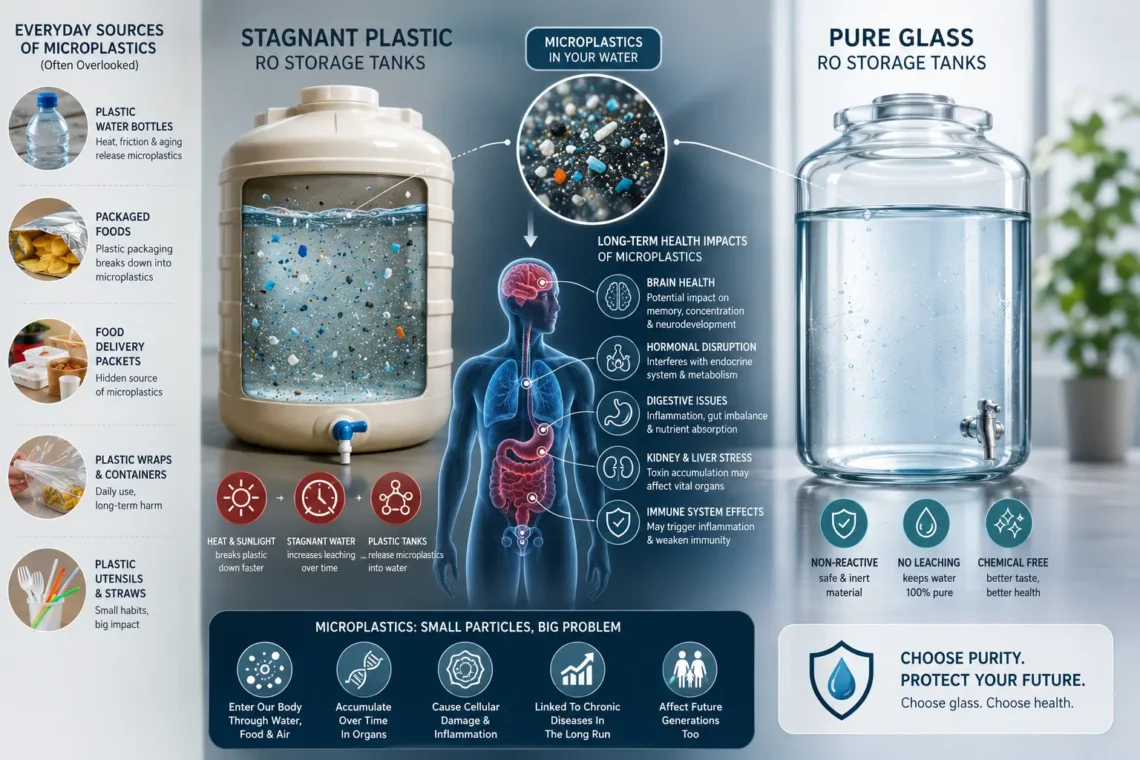
Most families let their purified water sit for hours inside the internal plastic storage tank built into their RO machine. While the reverse osmosis membrane does a flawless job of removing external contaminants, letting highly purified water stagnate inside a synthetic plastic container introduces a new, modern health anxiety: microplastic leaching.
Understanding how highly purified water interacts with internal plastic storage, and adopting a practical approach to modern food-grade storage, ensures your hydration remains genuinely pristine from the filtration stage straight to your glass.
The Science of Leaching: Why Purified Water Aggressively Extracts Impurities
Reverse osmosis filtration strips raw input water down to its purest elemental form. While this process guarantees absolute safety from toxic nitrates and pathogens, it leaves the output water highly demineralized and chemically hungry.
Pure, low-TDS water acts as a natural solvent. When this hungry, unmineralized water sits stagnant for 10 to 12 hours inside a standard commercial plastic reservoir, it slowly degrades the polymer walls of the tank through a process called chemical leaching.
This structural degradation introduces microscopic polymer fragments—known as microplastics and nanoplastics—directly into your drinking supply. Even if your machine is built using food-grade materials, long-term exposure to summer heat in un-air-conditioned NCR kitchens accelerates this material breakdown, compromising the integrity of your water just seconds before you drink it.
The Renter’s Solution: Transitioning to Smart Glass and Metal Storage
You do not need to replace your entire water purifier setup to eliminate microplastic exposure. Protecting your household simply requires shifting your secondary storage habits once the water leaves the filtration unit.
The most practical, health-first approach is to avoid using the internal plastic storage tank as your primary holding reservoir. Instead, treat your RO system as an on-demand purification plant: collect your fresh water daily and immediately transfer it into high-quality borosilicate glass bottles or premium food-grade stainless steel flasks.
Storing your drinking water in glass or metal inside your refrigerator completely eliminates secondary plastic contact. Glass is entirely inert and cannot leach chemicals, while stainless steel provides a stable, durable environment that keeps your purified water crisp, cool, and free from synthetic odors.
| Storage Material | Leaching Risk | Best Use Case for Households |
|---|---|---|
| Standard Internal Plastic Tank | Moderate to High When Stagnant | Temporary collection only; discard water left standing for days. |
| Borosilicate Glass Bottles | Absolute Zero Risk | Ideal for refrigerator storage; keeps water chemically pure and inert. |
| Food-Grade Stainless Steel | Zero Risk | Excellent for daily commuting, gym use, and keeping water cold. |
How Multi-Stage Rental Systems Bridge the Safety Gap
While shifting your storage containers protects your water after it leaves the tap, handling the baseline purity of your input supply requires a responsive, high-end filtration system.
Legacy water purifiers that rely on simple carbon blocks or low-pressure membranes cannot stop microscopic polymer particles that may already exist in municipal supply lines or local water tankers. To combat this effectively, your household needs a system armed with a dedicated Ultra-Filtration (UF) membrane alongside its primary RO core.
The hollow-fiber strands of a premium UF membrane act as a physical shield, mechanical-blocking microscopic microplastics, suspended colloidal matter, and bacterial debris before the water reaches the final tap. This ensures that the water filling your glass bottles is fundamentally free from synthetic contaminants from the start.
The Smart Alternative: You don’t need to commit to expensive, upfront appliance purchases to secure this level of advanced multi-stage protection. Choosing an RO+UV+UF+TDS+Alkaline water purifier on rent gives your home medical-grade particle defense, automated filter maintenance, and prompt 4-to-6-hour service support with zero investment costs and completely free lifetime maintenance.